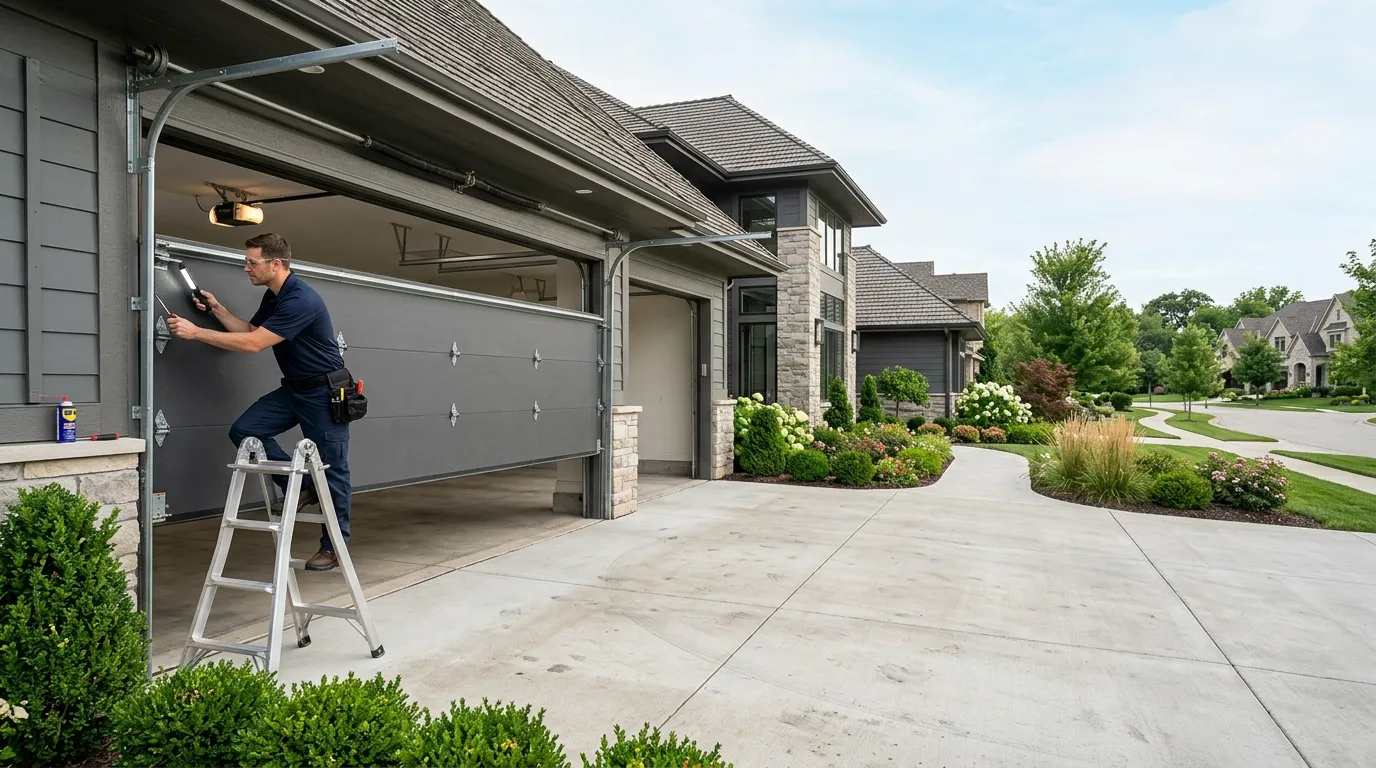
Elyria, OH · Garage Door Service
Grafton's homes run newer than most of the Elyria service area, built mostly around 1977. That changes which parts wear first and what a tune-up should check.
Most of the Elyria service area sits on housing built between 1938 and 2002, with a median year of 1967. Grafton runs newer than that average - the typical house here went up around 1977. That decade matters more than it sounds. A door installed in the late 1970s is more likely to have an extension-spring setup with the springs riding directly above the horizontal track, rather than the side-mounted torsion hardware that shows up more on the pre-1960s stock closer to the city center. Extension systems wear differently: the pulleys and support cables take the fatigue that a torsion spring would otherwise absorb, and safety cables (when they're even present on a door this old) are often the first thing to go missing over the years. On a Grafton door, we're usually checking pulley wear and cable containment before we look at anything else, because that's the failure pattern for a door of this age, not a torsion spring snapping at the drum.
Cold, severe winters across this whole service area add a second layer: lubricant that's fine in July gums up by January, and steel rollers on 1970s track pick up more resistance in the cold than the nylon rollers common on newer installs. None of that is unique to Grafton, but combined with the extension-spring era, it's a specific failure profile worth naming instead of a generic list of things that go wrong on garage doors.
You can do some of this yourself. Wipe down the track and check for rust or pitting, especially after a hard winter. Look at the extension springs for gaps between coils or visible stretching - that's a sign they're near the end of their life. Check that a safety cable actually runs through each spring; a lot of Grafton-area doors from the late 1970s were built or later retrofitted without one, and that's a real hazard if a spring lets go.
What you shouldn't do is put your hands anywhere near a spring under tension, or try to adjust cable length yourself. Extension springs store enough force to break a bone or worse, and there's no safe way to eyeball the right tension. Lubricating rollers and hinges with a garage-door-rated lubricant (not WD-40, which attracts grit) is fine for a homeowner. Diagnosing why a door is suddenly harder to lift, or replacing a frayed cable, is not a weekend project.
A maintenance visit on a house built around 1977 usually starts with the extension springs and their cables, since that's the era's weak point. We check spring tension against the door weight, look at pulley brackets for wear grooves, and confirm the safety cables are intact and correctly routed - a lot of older installs are missing this piece entirely and it gets added during the visit.
After that it's the standard pass: track alignment, roller condition, hinge wear, opener force settings, and weatherstripping at the bottom panel, which matters more here given the severe cold winters this area gets. We also check the balance of the door by hand - if it doesn't hold position halfway open, the springs are working harder than they should, which shortens the life of the opener motor too.
One honest limit: if the extension springs are original to a 1977 install, we're not going to "tune up" 45-year-old steel back to spec. At that point the maintenance visit turns into a conversation about replacement, because a tune-up on hardware that old is a short-term patch, not a fix.
We run this out of Elyria, about 7 miles from Grafton, so a maintenance visit here is a normal part of the route, not a special trip. We don't keep a separate branch or crew stationed in Grafton - the truck comes from Elyria - so we're not going to promise a response time specific to this town. What we can tell you is what to expect once someone's on site: a full check of the spring and cable setup given the age of housing stock here, plus the standard track, roller, and opener inspection.
If you're not sure whether your door needs maintenance or a repair, that's a fair question to ask when you call, and we'd rather answer it honestly than talk you into a visit you don't need.
On a Grafton door, the early warning signs tend to be specific: the door feels heavier to lift by hand than it used to, one side seems to drop faster than the other when closing, or you hear a scraping sound from the pulley area rather than a grinding sound at the spring itself. That scraping is often a pulley bearing wearing out, not a spring problem, which is a cheaper fix if it's caught early.
In winter, watch for a door that hesitates or stutters partway up - on older extension-spring setups, cold-thickened lubricant plus worn steel rollers is a common combination, and it's usually resolved with cleaning and re-lubricating rather than a parts replacement, assuming the springs and cables are otherwise sound.
Given that most homes in this part of the service area were built around 1977, extension springs above the horizontal track are more common than the side-mounted torsion setups you'd see on older housing closer to Elyria itself. We confirm the type on site since retrofits happen.
No. We run out of Elyria, about 7 miles away, and cover Grafton as part of that route. There's no separate branch here, so we won't promise a Grafton-specific response time - just an honest estimate when you call.
We don't have a fixed interval to hand you without knowing the door's exact history, but a door approaching 45 years old with original hardware needs more frequent checks than a newer install, particularly on the springs and cables.
Sometimes, sometimes not. If the springs and cables are original to a 1977 install, a maintenance visit often turns into a replacement conversation rather than a simple tune-up, because old steel spring stock is a short-term patch at that point.
Call now or request a free quote - same-day service on most repairs, upfront written pricing.