Elyria, OH · Garage Door Service
Westlake homes date mostly to 1983, later than most of this service area. That means different failure points: opener boards and rollers, not old torsion hardware. We drive the 11 miles from Elyria.
Most of the houses we service across this part of Ohio went up between 1938 and 2002, with a lot of that stock rooted in the 1960s and 70s. Westlake sits later than that curve - its median build year runs around 1983. That fifteen-to-twenty-year gap changes what actually breaks.
A 1983-built garage rarely still has the original one-piece door on side-mounted torsion hardware that we see further into the older parts of the service area. What we find instead is the first or second generation of sectional steel doors with extension or torsion springs mounted the way manufacturers standardized through the 80s, plus openers that have since been swapped once or twice. The failure isn't the hardware era - it's that those doors have now logged three, sometimes four decades of cycles, and the plastic idler wheels, worn hinges, and aging circuit boards on the opener are what give out first, not the spring itself.
Cold-climate stress plays into it too. This region sits in a severe cold band, and steel panels that flex with hard freeze-thaw swings eventually crack seams or loosen fasteners at the bottom bracket - a slower failure than a snapped spring, but one that shows up more in this later-era housing than in the oldest stock nearby.
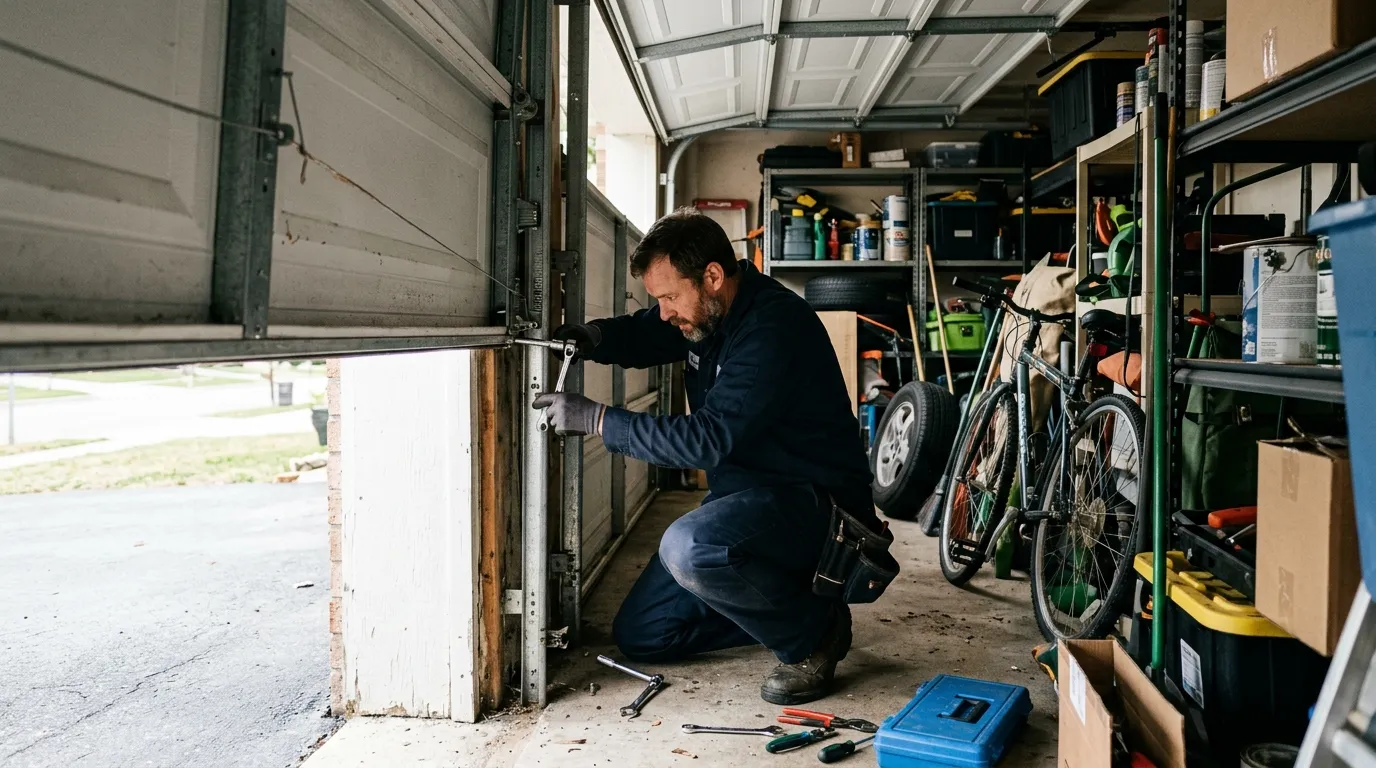
On a door from this era, the first sign is usually the opener, not the spring. You'll hear the motor run but the door won't move, or it reverses partway up for no reason - a symptom of an aging logic board or a safety sensor that's drifted out of alignment after years of garage temperature swings.
Rollers are the other common tell. Original steel or nylon rollers on doors built in this window are past their expected life, and you'll hear it before you see it: a grinding or popping sound as the door travels the track, worse in cold weather when the grease in the track has stiffened.
Less often, but still real for houses this age, the torsion spring itself has finally worn through its rated cycle count. That one's easy to identify - the door won't budge, or it slams down hard when the opener disengages. It's a straightforward fix, just not the one we see first in this neighborhood.
A roller replacement or opener board swap on a door this age is usually a same-visit job - parts for openers and rollers from the 1980s-2000s generation are common stock, not special order. A torsion spring replacement is also typically done in one visit once we're on site.
What takes longer is diagnosis when the symptom is intermittent - an opener that only misbehaves in certain weather, for example. We won't quote a fix over the phone for that kind of fault; it needs eyes on the unit.
We don't have a posted price list for this page, and we're not going to guess at a number that doesn't match what we'd actually charge once we've seen the door. What we can say is that repairs on a door from this era - roller sets, opener boards, spring swaps - tend to run cheaper in parts than a full teardown of an older side-mounted system, because the parts are still widely made.
Household income in this part of the service area runs well above the area median, and that does shift some decisions our way: more Westlake homeowners choose full opener replacement over patching a fifteen-year-old board once we explain the tradeoff, simply because the math works for them. That's their call to make, not ours to push.
Resetting opener travel limits or clearing a sensor that's gotten knocked out of alignment is something a lot of homeowners can do themselves, and we'd rather you save the call for that. Lubricating rollers and hinges with the right grease (not WD-40, which washes out over a cold winter) is also fair game.
What we won't talk you through over the phone is anything involving the torsion spring itself. Under tension, that spring can do real damage to a hand or a face, and it's not a place to save a service call. If the door won't move and you've checked the obvious - power, sensors, remote batteries - stop there and have someone look at it.
We run out of Elyria, about 11 miles from Westlake, and we don't keep a branch or a depot here - every job on this side of the service area starts with a drive out. If you're weighing whether a repair still makes sense on a door this age versus replacing it, that's worth a conversation before we quote anything. See our Westlake page for what we cover in this suburb, or check the main Elyria repair page for how we handle the job across the wider service area.
This area sits in a severe cold climate band, and garage temperature swings stiffen lubricant in the track and can throw off sensor alignment on older opener units. On doors from Westlake's build era, that's often the first sign of trouble, more common than a spring failure.
Possibly, but less likely than in older parts of the service area. Westlake's housing runs newer on average, so springs here have usually logged fewer cycles. Roller wear and opener board age tend to show up first on doors from this build period.
No. We run out of Elyria, about 11 miles away, and travel out for every job on this side of the service area rather than keeping a separate branch or depot in Westlake.
It depends on the board and how many cycles the unit has left in it. We'll look at the actual failure before recommending either way - we're not going to push a full replacement if a board swap solves it.
Call now or request a free quote - same-day service on most repairs, upfront written pricing.